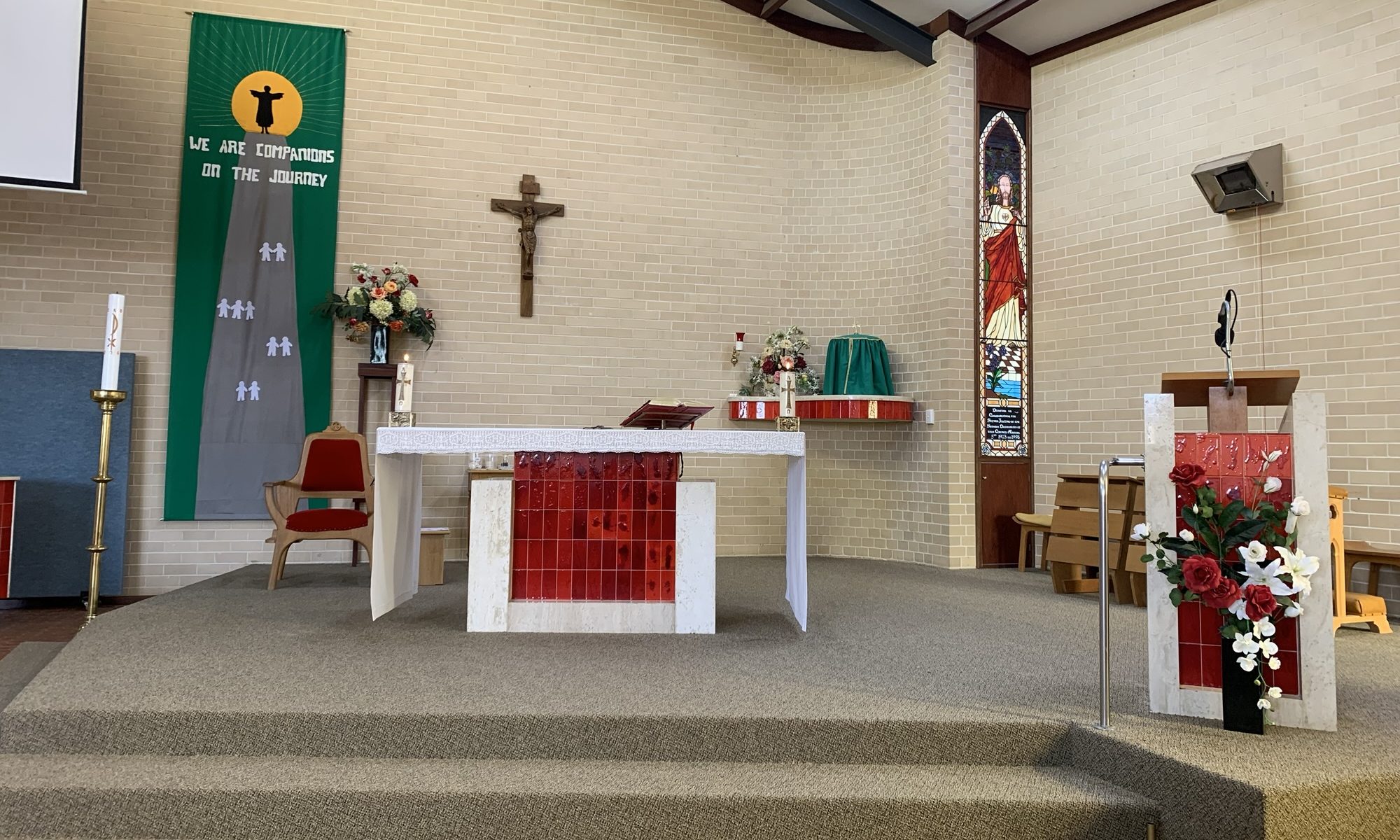
THE BODY & BLOOD OF CHRIST SUNDAY – YEAR A 2026

DEUTERONOMY 8: 2-3, 14-16
PSALM 147: 12-15, 19-20
1 CORINTHIANS 10: 16-17
JOHN 6: 51-58


Today we celebrate the heart of the mystery of the Eucharist. We believe that at the consecration in the Eucharistic prayer, the bread and wine becomes the Body and Blood of Jesus Christ. This is not just a sign or symbol but truly Christ present in the Eucharist in his body and blood, soul and divinity.

Our faith in the real presence of Jesus in the Eucharist comes from Jesus’ own words at the Last Supper: While they gathered for the meal, Jesus took bread, said the blessing, broke it, and giving it to his disciples said, “Take and eat; this is my body.”
Then he took a cup, gave thanks, and gave it to them, saying, “Drink from it, all of you, for this is my blood of the new covenant, which will be shed for the forgiveness of sins.

Some may say that he only meant it to be a symbol of his presence. Yet Jesus did not say that this is a representation of my body but that ‘This is My Body’.

In today’s Gospel, Jesus said, “For my flesh is real food and my blood is real drink. But the Jews complained, “This is intolerable language. How could anyone accept it?” In fact in the end, many of his disciples went away and did not follow him anymore. Jesus did not at that moment try to bring them back by saying that it was only symbolic language he was using. He meant what he said.

As that Gospel passage continues, Jesus then said to the twelve apostles, “What about you, do you want to go away too?” Simon Peter answered, “Lord to whom do we go, you have the message of eternal life.” We can only accept this through faith, faith in Jesus and in what he said.

At Mass when I raise the host and say, “Behold the Lamb of God, behold him who takes away the sins of the world. Blessed are those called to the supper of the Lamb” you respond with “Lord, I am not worthy to receive you under my roof but only say the word and my soul shall be healed.” These were that of a Roman centurion who had asked Jesus to cure his sick servant. When Jesus said he will go to his house, the Roman centurion replied, “Sir, I am not worthy to have you under my roof; JUST GIVE THE WORD and my servant will be cured.
Jesus praised his faith and said he has not seen such faith among the Jews. This is the faith we express in our similar words of Jesus’ real presence in the Eucharist.

And this is the heart of the mystery of the Eucharist, the Mass. We come to Mass, first and foremost because in here we are given the Bread of life given to us from the cross, his body and blood. Faith asks of us to let our lives be transformed by the sacrifice of love that we receive?

This belief in Jesus’ real presence in the Eucharist was a belief from the very beginning of the Church as St Paul’s letter to the Corinthians and the early Church writings show. In fact Christians were accused by the Romans of being cannibals eating human flesh.

For instance, Justin Martyr (c. A.D. 151): Justin described the Eucharist as a sacred food that is not common bread or drink but the flesh and blood of Jesus Christ. He wrote, “We call this food Eucharist, and no one else is permitted to partake of it, except one who believes our teaching to be true”

The early Church Fathers collectively affirmed the doctrine of the Real Presence, interpreting the Eucharist as the actual body and blood of Christ. This belief has been foundational in the development of Christian liturgy of the Eucharist throughout history.

TRINITY SUNDAY – YEAR A (2026)

EXODUS 34: 4-6, 8-9
PSALM: Dan 3: 52-56
2 CORINTHIANS 13: 11-13
JOHN 3: 16-18


Today we celebrate the “Feast of God.”
The Most Holy Trinity is one of the central belief our Catholic faith.
We profess our faith in this mystery every Sunday as we say the creed.
We profess our faith in this mystery every time we make the sign of the cross.

Our readings today talk to us about this amazing mystery: That our God is a communion of three divine persons in love — the Father, the Son and the Holy Spirit.

In our second reading St Paul in his blessing put the Son before the Father and the Holy Spirit. In a way this reminds us that our faith on the Holy Trinity is a revelation that comes from Christ himself.

Important passages from the Gospel in which Jesus proclaims are:
“The Father and I are One.”
“To see me is to see the Father.”
“The Paraclete, the Holy Spirit, whom the Father will send in my name, will teach you everything…”

The important understanding is that God is love which is revealed in the relations between the Father, Son and Holy Spirit in Holy Trinity. And the fruit of this love is life itself, life in being one with God, the Holy Trinity.

It is because God is love that God created all life.
It is because God is love that God gave of himself to us in the Son who came to live among us to save us and give us new life.
It is because of God is love that God gave of himself to us in the Holy Spirit that we may share in this new life.

Our response hopefully is to be open to the love of God that we may be open to receive the Holy Spirit and life with God.

As the Trinity are one, we are invited to be one in Trinity through God’s love for us that we may love God and our neighbour. It is our openness to the mystery of God’s love in our lives that we can come to understand in turn the deeper mystery of the Trinity.

Each time we make the sign of the cross, may it express our deepest faith in the Holy Trinity and our deepest desire to share in the love that comes in being in communion with the Holy Trinity.

PENTECOST SUNDAY – YEAR A (2026)

ACTS 2: 1-11

PSALM 103: 1, 24, 29-31, 34

1 CORINTHIANS 12: 3-7, 12-13

JOHN 20: 19-23


————————————————————————————–

Pentecost marks the beginning of the Church.

A new relationship is forged between God and us.

The Holy Spirit living in us makes real the glory of Jesus’ Resurrection in our lives.

The Holy Spirit gives us a deeper way of following God.

The Holy Spirit has come to transform our lives.

Jesus is the example for us in His own relationship with the Father. This is a time then to reflect on our relationship with God.

How real is Jesus alive in us?

Are we lukewarm in faith or do we feel a deep desire for God in our lives?

Are we more concern with laws rather than the love behind the laws?

The former would be reflected in our efforts in avoiding sin which is good but the latter will lead us to become life giving which is greater.

The law will tells us not to steal but love invites us to be compassionate in being generous.

Do we get caught up with our own opinions and expectations or are we respecting of each other, listening and respecting their needs and ideas?

Do we justify our hatred or dislike for others or do we seek healing and forgiveness?

And so we need to ask ourselves, is our faith just a profession of words or a lived out reality in our lives?

How real is Jesus alive in us?

The Holy Spirit has come to bring us to the loving relationship with God. 

Let us believe from the heart that we may gain all that God is offering to us.


ASCENSION OF THE LORD – YEAR A (2026)

ACTS 1:1-11
PSALM 46:2-3, 6-9
EPHESIANS 1:17-23
MATTHEW 28:16-20


The Ascension marks Jesus’ physical separation from the human story. But it is not a departure of Jesus from us. The Ascension celebrates Jesus’ unity with the Father.
It also celebrates the new relationship we are called to with God.

In the Gospel, Jesus tells the disciples that he will be with us till the end of time. We know that the Holy Spirit comes to live in us. But how real is this in our lives? Or is this just something we just simply believe but do not give it much thought?

In John’s Gospel, in praying for us, Jesus asks the Father that we may be one in them as he and the Father are one. Jesus now goes to the Father that we may come to know God as he knew the Father. This is Jesus’ invitation given to us: that we may be one with God.

Jesus taught his disciples about God. Jesus revealed God to them through his teachings, his ministry, and his life. But we will never know the meaning of this unless we live it out ourselves.

There is a difference between reading about a country and living in that country. God is not in some far-away place. Through his death and resurrection, Jesus has brought us to God.
Jesus has not gone to some far-away place. He said: “I will be with you always to the end of time.”

So where is God? God is there in every moment in our lives. It is whenever we see with the eyes of faith; hear with the ears of compassion; and touch with the hands of prayer that we will find God.

There was a religious Brother Lawrence who once lived in a monastic life. He worked in the kitchen in the monastery and was the happiest person in the monastery. When asked his reason, he replied because I meet God in everything that I do.

A lady once told me that she was always distracted by children when praying at Mass. I told her to embrace those children and love them and you will have a greater prayer in your heart than all the words you can find. Finding God begins with a desire for God’s love in our hearts.

The most difficult thing we do, can be turned into the happiest moment when we recognize God is there.

God is here: listen and see and touch and we will find God. Make everything we do a spiritual encounter with God and we will come to know his presence
and it will transform what we do
and it will transform who we are.

5TH SUNDAY OF EASTER – YEAR A (2026)

ACTS 6: 1-7
PSALM 32: 1-2, 4-5, 18-19 R. v.22
1 PETER 2: 4-9
JOHN 14: 1-12


As we come to the climax of Jesus’ mission in John’s Gospel, he calls his disciples to trust in God and trust in him. He then tells them to follow him for he is, the Way, the Truth and the Life. People will only follow those they trust, and trust those they love and love those they know.

There is a prayer of St Richard of Chichester that precisely reflects this call to us.
It goes like this:
O most merciful redeemer, friend and brother, may I know you more clearly, love you more dearly and follow you more nearly, day by day.

The first question for us then is how well do we know Christ? A relationship with Christ can only be real through an openness to Christ as he was open to the Father’s will. It is through prayer and the Sacraments, the scriptures and living in God’s love. When these become part of our daily life, we will come to know Christ.

But all this won’t happen unless there is a desire in us for Christ in our lives. This is what St Peter is saying in the second reading: Jesus is our foundation stone. What we must ask ourselves is how does our desire for Christ compare with our other desires in life.

We believe that Jesus rose again and through his resurrection has won for us eternal life.
And because we believe, let us remember that only Christ can give what no other can give, eternal life. That is the reason we follow him.

There are many people who are converting to Christ when they come to know him, his teachings and his love for us by his death and resurrection. But there are many more who do not know Christ. And they will not know Christ except through us.

In the Gospel reading, Philip asked Jesus, “Let us see the Father and we will be satisfied.”
Jesus’s answered Philip, “To have seen me is to have seen the Father. You must believe me when I say that I am in the Father and the Father is in me; believe it on evidence of this work, if for no other reason.”

People will see and know Christ when we become the face and love of Christ to them. May Christ be a deep part of our lives, part of who we are; for after all this is what it means to be a Christian. As the Father lived in Christ, may Christ live in us and others come to know God through us.

May there be a great desire in our hearts to know Christ that we may love him and follow him even to the cross.

4TH SUNDAY OF EASTER – YEAR A (2026)

ACTS 2: 14, 36-41
PSALM 22: 1-6
1 PETER 2: 20-25
JOHN 10: 1-10


Today is Good shepherd and so is also Vocations Sunday, when we are called to pray for more vocations to the priesthood and also pray for priests and bishops who serve the Church today, that they may be strengthen to be faithful to the call God has given them.

We also know Jesus who is the Good Shepherd. Some may ask though today where is the God, the Good Shepherd? If God is the Good Shepherd, why does he not help us today?

There is a story of a long time past of a little boy whose parents had died and was raised by his aunt. Years later after he had grown up, he received a letter from his aunt. She had a terminal illness and from the tone of her letter he knew that she was afraid of death.

He then wrote a letter to her a letter which read:
“When I was a little boy of six feeling so alone, you sent me word that you would give me a home and be a mother to me. I’ve never forgotten the day when I made the long journey to your house. I was so disappointed when, instead of coming for me yourself, you sent your servant, Caesar, to fetch me. I well remember my tears and my anxiety as I sat on the high horse, clinging tight to Caesar as we rode to my new home.

As night fell and it drew dark before we reached your home I became even more afraid.
“Do you think that she will go to bed before I get there?” I asked Caesar. “Oh No,” answered Caesar. “She’s sure to stay up for you. Soon you will see her light shining in the window.”

Then as we rode in sight of the house, there was your light shining. I remember that you were waiting at the door; that you put your arms tight around me; that you lifted me, a tired, frightened boy, down from the horse. You had a fire burning and a hot supper waiting on the stove. After supper you took me to my new room; you heard me say my prayers and then you sat with me until I fell asleep.

I tell you this story because very soon, God is going to send for you, and take you to a new home. I’m trying to tell you that you needn’t be afraid of this summons or the strange journey or of the dark message of death. God can be trusted: God can be trusted to do as much as you did for me so many years ago.

At the end of the road you’ll find love and a welcome waiting. And you’ll be safe in God’s care. I’m going to watch and pray for you until you’re out of my sight. And I shall wait for the day when I make that same journey myself and find you waiting to greet me.”

No matter what road our present journey takes at this time, the Good Shepherd is always there with us.

Pope Francie in speaking to the youth one day had this to say when asked: “How can we see God’s hand in the tragedies of life? ”He replied: I’ll tell you a secret. In my pocket I carry two things: a Rosary, to pray, and something else which may seem a little odd….What is it?
It’s the story of God’s failure: it is a little Way of the Cross, the story of how Jesus suffered from the time he was condemned to death until his burial. With these two things, I try to do my best. But thanks to these two things I don’t lose hope.”

Even in the darkest of moments our Good Shepherd walks with us.

GOOD SHEPHERD SUNDAY is about the hope we have because God is with us ALWAYS
It is the promise He made to us.

3RD SUNDAY OF EASTER – YEAR A (2026)

ACTS 2: 14, 22-33
PSALM 15: 1-2, 5, 7-11
1 PETER 1: 17-21
LUKE 24: 13-35


The two disciples in the Gospel story are leaving Jerusalem. By leaving Jerusalem, in a way they are turning away from Jesus. And they do so because they are despondent, things have not turned out the way they were hoping.

The road to Emmaus is familiar road that we all take. It represents the road of disappointment, failure, sorrow, grief, shattered dreams, suffering. Our sufferings, our problems, hurts and wounds can acquire a lot of power over us and lead us to despair.

We all know people who have left the Church for one reason or another. It may be because of a bad experience in the Church, or because of a life experience in which they have felt abandoned by God or the Church.

Each of us would have experienced tragedies and bad experiences that can challenge our faith. In some way today’s Gospel story could be our story.

As in the story though, we see that Jesus will not abandon us. We may not recognize his presence because our despair and bitterness have blinded us to His presence, but he is there with us. But what makes some people persevere in faith and continue the journey?

On the road to Emmaus, Jesus on that road spoke to them of the scriptures that spoke of him. For them, the scriptures were very much the heart of their faith and understanding of God’s presence to them. As Jesus spoke, their hearts burned within them.

For us too, our faith in God is central. Our faith in God should never be taken for granted. It is our faith that leaves a door open to God.

However, if our faith is founded on a relationship with certain Church leaders who we admire and not on God who saved us, then we follow a dangerous road. For people even our leaders are weak and do fail in their own journey but God is holy and always faithful to us. Our faith must always be on God.

This is the time then for prayer and the sacraments. In the story, we saw how the scriptures touched their hearts and how the disciples recognize Jesus at the breaking of bread, the Eucharist. Prayer, reflecting on the scriptures, the story of God’s love for us, and the Sacraments are gifts to help us know God that we may grow in faith and trust in God.

And there are also a lot of other people out there wounded in their faith, struggling to find God in their lives. Our response should never be one of condemnation but of compassion.
Like Jesus, we should walk beside them always ready to support them.

As Jesus explained the scriptures to them, we could do the same. But the scriptures we explain should also be the one that is written in our soul, our own experience of God. It is not so much spoken with words but through action: our own love for God and our love for our neighbour.

Never abandon a wounded brother or sister to struggle alone. We are God’s Church, God’s family. Never give up in the face of evil in the world.

Never give up faith and hope in God.
Jesus said, “I am there with YOU always, till the end of time.”