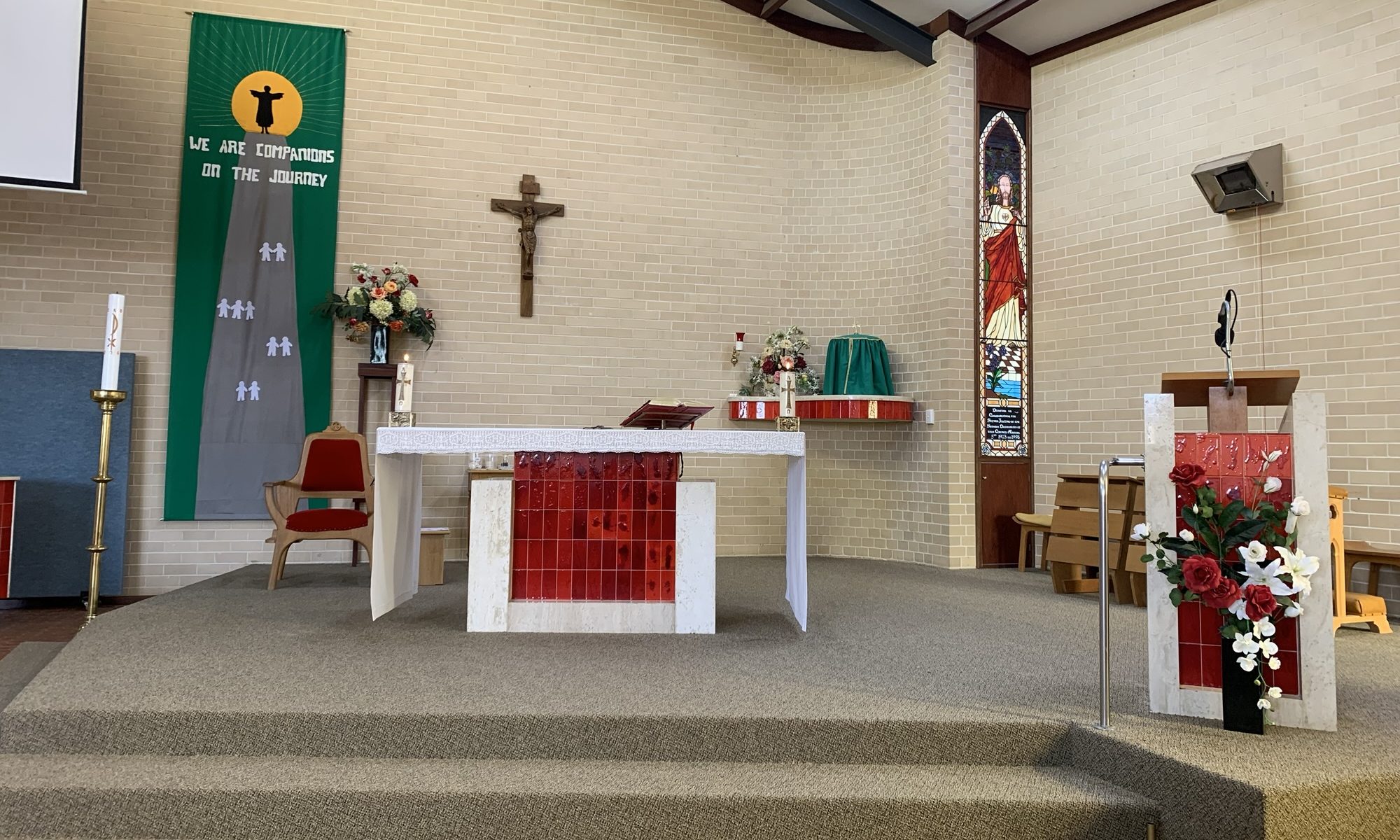
The Easter Triduum (or Paschal Triduum) is the three-day celebration spanning from the evening of Holy Thursday to the evening of Easter Sunday, marking the summit of the liturgical year in Catholic and many Christian traditions. It commemorates the passion, death, and resurrection of Jesus, celebrating the Paschal Mystery as one single, continuous act of redemption.
Merredin
Holy Thursday 2nd April – 630pm Mass of the Lord’s Supper
Good Friday 3rd April – 300pm The Passion of the Lord
Holy Saturday 4th April – 630pm Easter Vigil Mass
Easter Sunday 5th April – 1030am Mass
Kellerberrin
Good Friday 3rd April – 1000am Stations of the Cross
In the first reading, to a people in Exile, through the Prophet Ezekiel, God tells the people: “I shall put my spirit in you and you will live……”
In the second reading, St Paul in his most profound letter, tells the people that ‘the Spirit of God has made his home in them.’ He writes, ‘And if Christ is in you then your Spirit is life itself.’
And in the Gospel in Jesus we see the purpose of the gift of the Spirit, that God may be glorified.
This Easter, Adam will be received into the Catholic Church through the sacrament of Baptism. What does our baptism mean to us? Through our baptism, we are given the fruit of Jesus death and resurrection: a new life in the Holy Spirit. Today, let us ask ourselves, ‘How is the Holy Spirit within me, life giving?’
The challenge to us today is that sometimes we can feel bounded by our sins or feel we are not good enough that we despair. We end up being like Lazarus in the tomb. We can sometimes feel it is not possible to change and so close the tomb we are in and not allow Jesus to free us.
Yet, if we say we believe then believe that Jesus can transform our lives because he has risen.
The words that Jesus speaks to Martha in today’s Gospel, he is saying to us today also. “I am the Resurrection and the life. If anyone believes in me, though he dies, he lives, and whoever lives and believes in me will never die. DO YOU BELIEVE THIS”
In Baptism, through the Holy Spirit we are made into the image of Christ. As St Peter said as Jesus is Priest, Prophet and King, so are we through our baptism.
As priest, Jesus was a person of prayer who taught us how to prayer and prayed for us. Sometimes people can avoid prayer because they think it is too difficult and too time consuming. Prayer is simply a talking to God: a simple thank you or sorry or a asking for a blessing on a person in need or for ourselves. What is important in prayer is not length of time but a sincere love in our hearts and faith in God.
As prophet, Jesus proclaimed God’s mercy and God’s way and God’s almighty power. We are all prophets of God when we live out our Christian virtues in seeking right relationship with our neighbour, even those who hate us. We are all prophets of God when we gather to worship God, for in so doing we are telling the world the importance of having a right relationship with God.
Another image of the king is that of the Good Shepherd. As the Good Shepherd, Jesus cared for the sick, the poor and the sinner. In so doing he revealed God’s mercy and compassion. We are called to share in Jesus’ kingship by being shepherds who care for those in need, the poor, the sick, the lonely, the outcaste, the sinner even the enemy in need.
Yes, if we say we believe then believe that Jesus can transform our lives even today, because he has risen and with him we too will rise.
1 SAMUEL 16: 1, 6-7, 10-13 PSALM 22 EPHESIANS 5: 8-14 JOHN 9: 1-41
In the year 403, after the troops of the Emperor Honorius had defeated his enemies, great games were held in Rome to celebrate this victory. These games included gladiatorial games where men fought and killed one another. This was even though Christianity was now the official religion in the Roman Empire and even Christians attended these games.
Saint Telemachus, a monk, determined to show that Christian love could not tolerate this, travelled to Rome, obtained entrance to the amphitheatre, and when the fight began leapt over the barrier to part the gladiators. The crowd of people shouted with rage and started throwing stones and other missiles at St Telemachus. He was soon pelted to death.
But the sight of him lying dead cooled their rage and opened their eyes to their cruelty. The emperor called his death a martyrdom and he went on to ban the gladiatorial games and the people agreed.
Lent is a time of growing in our faith in God. It is a time to ask ourselves, ‘Where is Jesus in my life today? What is Jesus saying to me?’ To answer that question, we need to ask ourselves, ‘what does the crucifixion of Jesus mean to us?”
The cross is the symbol of God’s love and what that Love calls for is compassion, mercy and sacrifice. The voice of Christ is always there calling us to his love.
St Telemachus could recognize the evil of the gladiatorial fights and went on to right a wrong. He heard the voice of Christ to right a wrong. St Francis of Assisi came to encounter Jesus when he embraced a leper. St Theresa of Calcutta came to see the face of Christ in the destitute and dying of the city. St Mary of the Cross MacKillop began her mission to serve the poor and educate underprivileged children due to her faith in Christ calling her to help those in need.
I know in my own life how Christ has spoken to me through others even people of other faiths and no faith.
As the children in our parish make their commitment to preparing for the Sacraments of Reconciliation, Holy Communion and Confirmation, it is a reminder to us that the ‘Sacraments of the Church’ is the voice of God speaking to us.
What stops us from hearing the voice of Christ are own sinfulness and our prejudices and judgment of others and our pride. That was what blinded the Pharisees. They had already made their judgment of Jesus and simply because they did not like what he taught.
The difference between them and the blind man is that the blind man could recognise his own poverty and so his need of God. The question we need to ask ourselves is how much do we recognise our own need of God? How well are we willing to listen and follow Christ?
Jesus is there with us always, speaking to us, waiting for us to recognize him. When we open our hearts, our eyes to the love of the cross that is filled with compassion, mercy and a willingness for sacrifice that we will come to hear the voice Christ.
May our experience of the Cross of Jesus help us to more fully understand the meaning of the Resurrection and so hear the voice of God speaking to us.
What is the extent of your faith experience of God’s loving presence in your life?
Do you find that being a Christian, being a Catholic, gives you meaning and is life giving or do you find it an intrusion in your lifestyle? Do you always seek time for prayer and long for the Mass or do you find it difficult to pray and see the Mass as just an obligation to fulfill?
For some people, their faith in God is so important that there is always a desire to seek to grow in their relationship with God. For some, it can be meaningless that they give a limited or minimum time to that relationship and they are always finding excuses to let go of their Catholic beliefs and practices.
In today’s Gospel, we see the growing of faith in the Samaritan woman in her encounter with Jesus. She is at first taken aback by Jesus, a Jew coming to speak to her, a Samaritan, for Samaritans and Jews hated each other. She then came to think that Jesus must be a prophet. Later she wondered if he was the Messiah. Eventually with the people, she realized that he was indeed the Saviour of the world.
Contrast this with the people in the first reading. Here was a people were freed from slavery by God. And God had given them so much to survive in their desert journey. But now they are grumbling. They had forgotten what God had done for them. Many still do today. They do so because they do not know and do not trust God.
Grumble about having to go to Mass or why it is so long, or that it is boring.
In contrast, this is what St Paul wrote in today’s second reading: “That through Jesus, God has poured out his love upon us to save us from our sins even though we did nothing to deserve it.” Nothing can be compared with God’s great love for us.
Sometimes we may not appreciate the promise and gift that Jesus offers us because, like the Samaritan woman, we do not understand. In the Gospel Jesus tells the Samaritan woman and us: ‘If you only knew what God is offering and who it is that is saying this to you.’ Personally, I know that there is still so much that I still have to understand.
Lent is a time when we are invited to become like the Samaritan woman and to listen, to understand, to know and so let the living Word of God live in us. There is something that Jesus is offering us in this life that will live forever.
All the worldly things that we may like, will pass away. Ask the Olympic stars and the movie stars of the past. Who remembers them today and would like to meet them? They cannot re-live their past.
On the other hand what Jesus offers us, no one can take away. It gives meaning to life and life itself. It gives us eternal life
Jesus is saying to us, “Give me a drink.” He is calling to open our hearts to him that we may then be able to see his heart of love which is life giving, to encounter him like the Samaritan woman. It is then that our faith experience will be transformed and we will desire to grow ever closer to God.
Let us reflect then: ‘What then has your last encounter with Jesus been like? What did Jesus say to you?’