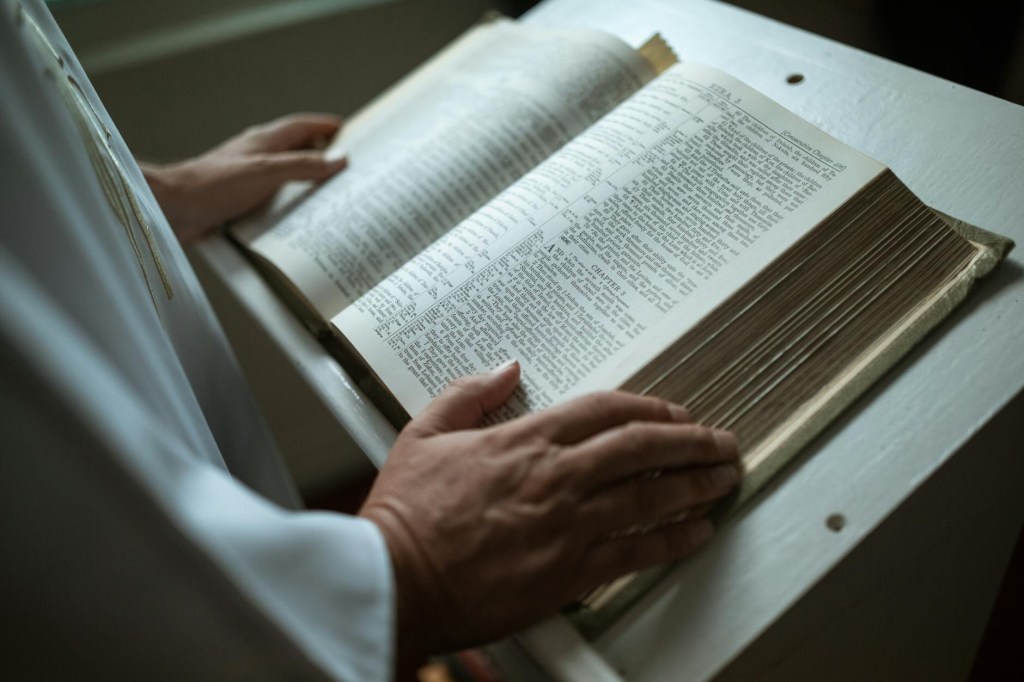
DEUTERONOMY 8: 2-3, 14-16
PSALM 147: 12-15, 19-20
1 CORINTHIANS 10: 16-17
JOHN 6: 51-58
Today we celebrate the heart of the mystery of the Eucharist. We believe that at the consecration in the Eucharistic prayer, the bread and wine becomes the Body and Blood of Jesus Christ. This is not just a sign or symbol but truly Christ present in the Eucharist in his body and blood, soul and divinity.
Our faith in the real presence of Jesus in the Eucharist comes from Jesus’ own words at the Last Supper: While they gathered for the meal, Jesus took bread, said the blessing, broke it, and giving it to his disciples said, “Take and eat; this is my body.”
Then he took a cup, gave thanks, and gave it to them, saying, “Drink from it, all of you, for this is my blood of the new covenant, which will be shed for the forgiveness of sins.
Some may say that he only meant it to be a symbol of his presence. Yet Jesus did not say that this is a representation of my body but that ‘This is My Body’.
In today’s Gospel, Jesus said, “For my flesh is real food and my blood is real drink. But the Jews complained, “This is intolerable language. How could anyone accept it?” In fact in the end, many of his disciples went away and did not follow him anymore. Jesus did not at that moment try to bring them back by saying that it was only symbolic language he was using. He meant what he said.
As that Gospel passage continues, Jesus then said to the twelve apostles, “What about you, do you want to go away too?” Simon Peter answered, “Lord to whom do we go, you have the message of eternal life.” We can only accept this through faith, faith in Jesus and in what he said.
At Mass when I raise the host and say, “Behold the Lamb of God, behold him who takes away the sins of the world. Blessed are those called to the supper of the Lamb” you respond with “Lord, I am not worthy to receive you under my roof but only say the word and my soul shall be healed.” These were that of a Roman centurion who had asked Jesus to cure his sick servant. When Jesus said he will go to his house, the Roman centurion replied, “Sir, I am not worthy to have you under my roof; JUST GIVE THE WORD and my servant will be cured.
Jesus praised his faith and said he has not seen such faith among the Jews. This is the faith we express in our similar words of Jesus’ real presence in the Eucharist.
And this is the heart of the mystery of the Eucharist, the Mass. We come to Mass, first and foremost because in here we are given the Bread of life given to us from the cross, his body and blood. Faith asks of us to let our lives be transformed by the sacrifice of love that we receive?
This belief in Jesus’ real presence in the Eucharist was a belief from the very beginning of the Church as St Paul’s letter to the Corinthians and the early Church writings show. In fact Christians were accused by the Romans of being cannibals eating human flesh.
For instance, Justin Martyr (c. A.D. 151): Justin described the Eucharist as a sacred food that is not common bread or drink but the flesh and blood of Jesus Christ. He wrote, “We call this food Eucharist, and no one else is permitted to partake of it, except one who believes our teaching to be true”
The early Church Fathers collectively affirmed the doctrine of the Real Presence, interpreting the Eucharist as the actual body and blood of Christ. This belief has been foundational in the development of Christian liturgy of the Eucharist throughout history.
 Merredin Catholic Parish